The idea
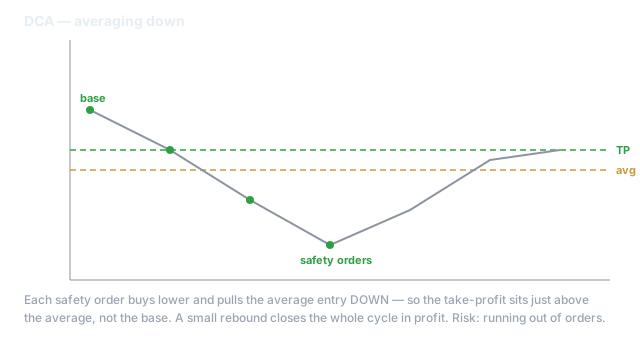
DCA (Dollar-Cost Averaging) opens a position and, if price moves against it, adds to the position at lower prices. Each safety order pulls your average entry down, so price doesn't need to return to the original entry — only to the (lower) average + take-profit — to close in profit.
Grid vs DCA — what's different
- •Grid profits from oscillation: many small buy→sell pairs inside a range.
- •DCA builds one averaged position and exits it whole at a target. It's about surviving a drawdown and recovering, not scalping the range.
Key parameters
- •Base order: the first entry size.
- •Safety orders: how many averaging buys, and at what price steps.
- •Step scale (price deviation multiplier): widen the gap between successive safety orders so you don't exhaust them too fast.
- •Volume scale (martingale): make each safety order larger than the last to pull the average down faster — powerful but increases risk and capital use.
- •Take-profit %: target above the average entry where the whole position closes.
The risk to respect
DCA's weakness is a sustained downtrend: you can run out of safety orders while price keeps falling, leaving a large floating loss. Counter it with: enough capital reserved for all safety orders, a sane volume scale, a floating-loss guard, and optionally a hedge. Never size a DCA system assuming price always comes back.