What Market Making is
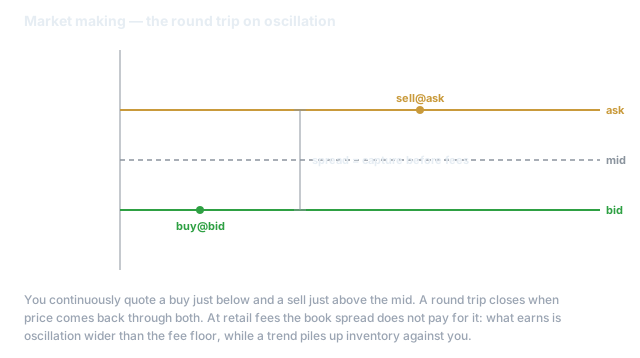
Market Making continuously quotes both a buy (bid) and a sell (ask) order around the mid price, a set distance apart, and closes a round trip when price comes back through both. Inventory builds organically as one side fills more than the other.
What it is NOT
A professional market maker stands at the touch — its quotes are the best in the book — and lives on a maker rebate. On the fee rates available to you that game does not exist: a round trip costs roughly 20 basis points in fees, while the entire bid/ask spread of a liquid pair is a fraction of one. Our own fee floor admits it and pushes the quote far outside the touch — on ETH some 750× further from mid than the best order in the book.
So the quote is not providing liquidity at the touch. It fills when price travels to it, which makes this a strategy that earns on oscillation and loses on trend.
Key parameters
- •Spread (half-spread, per side) — how far the quotes sit from mid. It must clear maker fee + 0.05%, or the engine pauses the system, and realistically 0.25% or more to also cover inventory drift. Wider = more per round trip, fewer fills.
- •Order size / re-quote interval — how much you quote and how often you re-center as the mid moves.
- •Inventory cap — the ceiling on how much of the asset the system may accumulate.
When to use it
- •Spot pairs whose swing is wider than the fee floor. Pick by amplitude, not by book depth.
- •Sideways regimes, where price keeps coming back through your quotes.
When NOT to use it
- •Trending markets — only one side fills and inventory piles up against you.
- •Ultra-tight, ultra-liquid books: the quote stands far from the market and rarely fills at all.
The pitfall
Inventory risk — and it is the main cost, not fees. Measured across every market-making system on the platform, drift on held inventory cost about twice what commissions did. In a trend you keep filling one side and the mark-to-market loss on that growing position dwarfs the round-trip income: on a trending pair a system lost 78.8 b.p. of turnover, while on a volatile, oscillating one another earned 22.3. Cap inventory, respect the spread floor, and stay out of trending regimes.