What Range Grid is
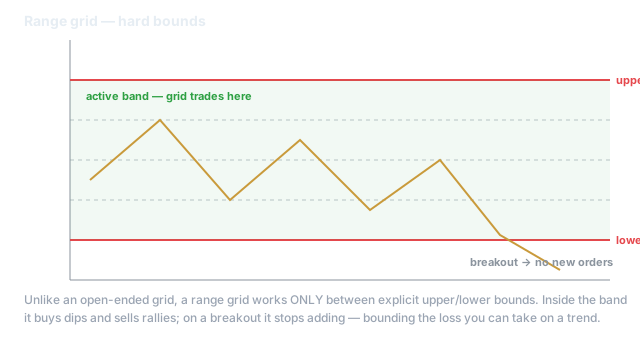
Range Grid places evenly spaced buy and sell limit orders inside a band you define — a lower bound and an upper bound. Price crossing a line down fills a buy; crossing the line above sells it back. It "ping-pongs" the corridor, booking small profits on each oscillation.
Unlike an adaptive grid, Range Grid is transparent and fixed: you see exactly where every line sits, because you set the band. What you see is what it trades.
Key parameters
- •Lower / upper bounds — the price corridor. The whole strategy lives or dies here.
- •Number of levels — how many lines split the band. More levels = smaller steps, more (smaller) trades.
- •Distribution — arithmetic (equal price steps) or geometric (equal percentage steps).
When to use it
- •A clear sideways channel in a price corridor you expect to hold.
- •When you want a predictable "by the lines" grid rather than an adaptive one that moves on its own.
When NOT to use it
- •A trending market. If price breaks out below your lower bound, the grid stops working and you're left holding the position bought inside the range — a losing bag until price returns.
The pitfall
Choosing the band wrong. Too narrow and price leaves it immediately; too wide and your capital spreads thin with little income. Anchor the bounds on real support and resistance, and set a stop-loss beyond the band so a breakout doesn't turn into an open-ended loss.